
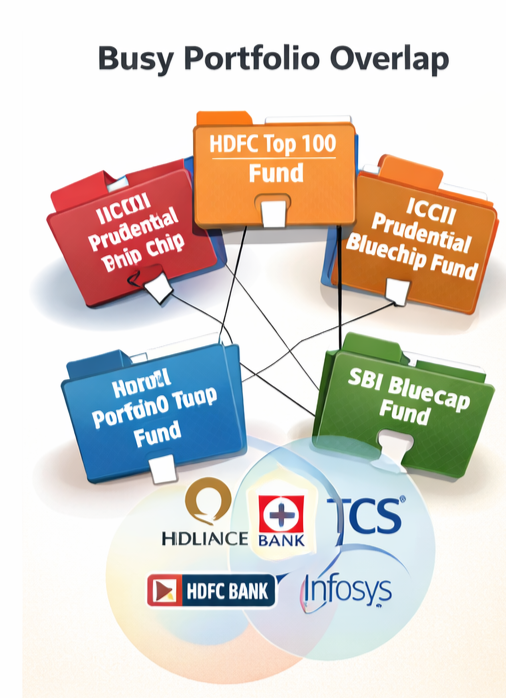

Many investors open their account and feel confident when they see a busy portfolio filled with multiple mutual funds. At first glance, everything looks diversified and active. However, this is often where mutual fund overlap quietly enters the picture. Understanding the 7 signs of mutual fund overlap helps explain why a portfolio can look well spread out on paper but still fail to deliver the results investors expect over time.
This confusion is very common. A busy portfolio creates the feeling of safety. It feels like risk is spread out. In reality, activity does not always mean diversification. Many portfolios look large but behave very similarly to each other. AMFI explains why understanding mutual fund diversification and risk is important for long-term investors. https://www.amfiindia.com/investor-corner/knowledge-center.html
One of the biggest reasons for this is mutual fund overlap.
Different funds often hold the same companies. The fund names sound different. The strategies sound unique. Under the surface, the holdings are very similar. Because of this, owning many funds does not always reduce risk or improve returns.
For example, many large-cap funds in India hold the same core stocks. Funds like HDFC Top 100 Fund, ICICI Prudential Bluechip Fund, and SBI Bluechip Fund all invest heavily in companies such as Reliance Industries, HDFC Bank, Infosys, and TCS. If an investor holds two or three of these funds together, the portfolio may look diversified. In reality, the same companies dominate the portfolio again and again.
This overlap means that when these large stocks do well, all funds move together. When they struggle, all funds struggle together. The number of funds increases, but the behaviour remains the same.
The same issue appears in flexi-cap and multi-cap funds. Funds like Parag Parikh Flexi Cap Fund and Kotak Flexicap Fund may look different on paper. However, they often share large positions in top Indian companies. Holding multiple such funds often leads to repeated exposure rather than meaningful diversification.
Another common overlap happens between index funds and active funds. Many investors hold a Nifty 50 index fund and also add a large-cap active fund. Since most large-cap funds closely follow the index, the portfolio ends up repeating the same stocks. The investor pays extra costs without gaining much difference in behaviour.
Because overlap is not visible at first glance, investors rarely notice it. Apps show different fund names and different charts. Without checking holdings, it feels like everything is covered.
Another reason busy portfolios underperform is lack of role clarity. Every investment should have a purpose. Some money should focus on growth. Some money should provide stability. In many portfolios, everything tries to do everything. Aggressive funds are expected to protect capital. Conservative funds are expected to generate high returns. This confusion creates disappointment.
Busy portfolios also grow because of performance chasing. A fund that did well last year looks attractive. A sector that recently rose sounds exciting. Instead of reviewing the overall structure, investors keep adding new funds. Over time, the portfolio fills up with past winners. Market cycles change. Returns slow down.
Costs also play a role. Each mutual fund charges an expense ratio. Individually, these costs feel small. Together, they quietly reduce returns. More funds mean more hidden drag on performance.
Reviewing such portfolios becomes difficult. With too many funds, investors avoid reviewing at all. Rebalancing gets delayed. Small problems remain unsolved. Over time, the portfolio drifts away from its original purpose.
The biggest issue, however, is lack of goal connection. Many portfolios are built without clear timelines. Short-term money sits in volatile funds. Long-term money gets diluted across conservative options. When goals are unclear, performance always feels unsatisfactory.
A simpler portfolio behaves better because it is easier to understand. Fewer funds with clear roles make decision-making easier. Tracking becomes simpler. Reviews become meaningful. Allocation stays intentional.
To understand why structure matters more than activity, it also helps to step back and think about investing from a long-term perspective. You can read more about this approach here: https://waradefinblog.blog/how-to-think-about-long-term-investing/
This does not mean fewer funds automatically give higher returns. It means clarity improves behaviour. Better behaviour leads to better long-term outcomes.
A well-structured portfolio may look boring. It may not change often. It may not create excitement. Yet, over time, it often performs better because it avoids unnecessary overlap and emotional decisions.
The key idea is simple. A portfolio should work like a team. Each investment should know its role. When everything tries to do everything, nothing does its job well.
If your portfolio looks busy but results feel average, the problem is not effort. The problem is structure.
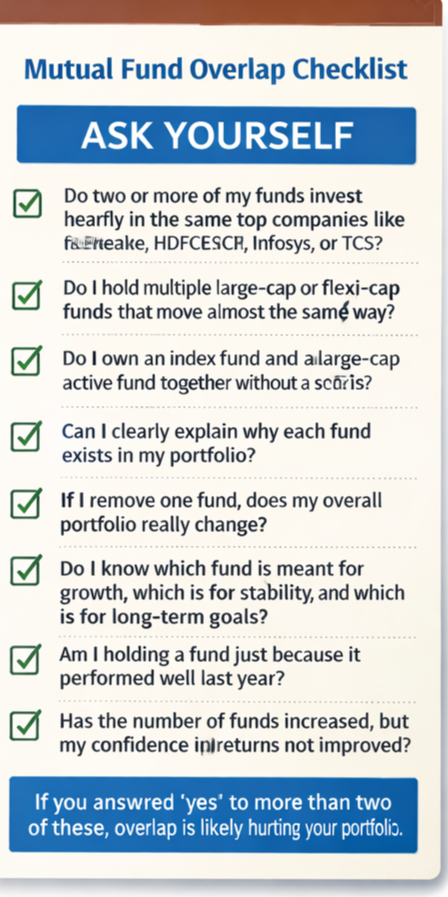
Use this checklist whenever you review your portfolio.
You don’t need tools to understand it. Just honesty.
Ask yourself these questions:
- Do two or more of my funds invest heavily in the same top companies like Reliance, HDFC Bank, Infosys, or TCS?
- Do I hold multiple large-cap or flexi-cap funds that move almost the same way?
- Do I own an index fund and a large-cap active fund together without a clear reason?
- Can I clearly explain why each fund exists in my portfolio?
- If I remove one fund, does my overall portfolio really change?
- Do I know which fund is meant for growth, which is for stability, and which is for long-term goals?
- Am I holding a fund just because it performed well last year?
- Has the number of funds increased, but my confidence in returns not improved?
If you answered “yes” to more than two of these, overlap is likely hurting your portfolio.
Eaxmple :-
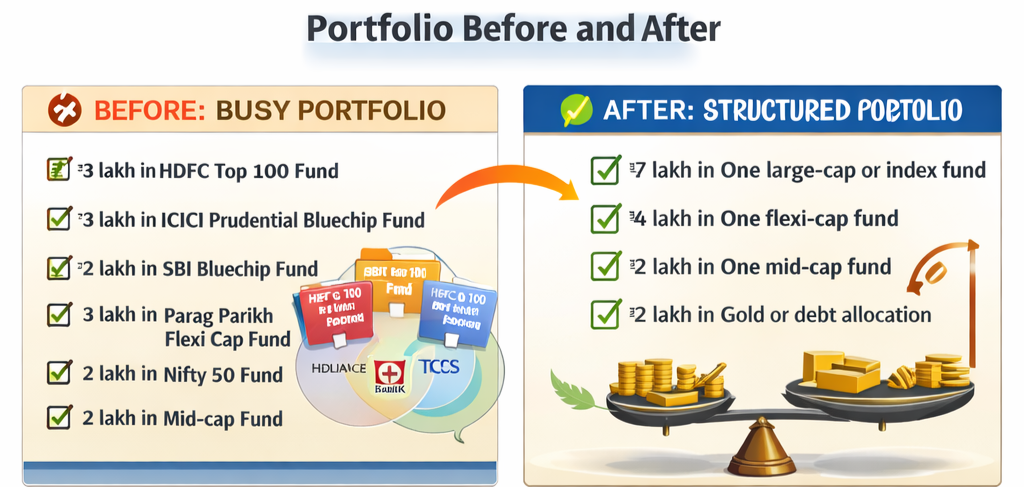
An investor with ₹15 lakh invested:
- ₹3 lakh in HDFC Top 100 Fund
- ₹3 lakh in ICICI Prudential Bluechip Fund
- ₹2 lakh in SBI Bluechip Fund
- ₹3 lakh in Parag Parikh Flexi Cap Fund
- ₹2 lakh in a Nifty 50 Index Fund
- ₹2 lakh in a Mid-cap Fund
What’s actually happening:
- Heavy exposure to the same large-cap stocks
- Index fund + large-cap funds repeating each other
- Too many funds doing similar jobs
- Portfolio looks big, but moves like one block
Returns feel average. Reviews feel confusing.
After: A Structured Portfolio (Fewer Funds, Clear Roles
Same ₹15 lakh, restructured:
- ₹7 lakh in one large-cap or index fund (core growth)
- ₹4 lakh in one flexi-cap fund (growth + flexibility)
- ₹2 lakh in one mid-cap fund (higher risk, long-term growth)
- ₹2 lakh in gold or debt allocation (stability)
What changes:
- Each investment has a clear role
- Overlap reduces sharply
- Portfolio behaviour becomes easier to understand
- Reviews become simpler
- Emotional stress reduces during market falls
The goal is not higher returns overnight.
The goal is better control and consistency over time.