
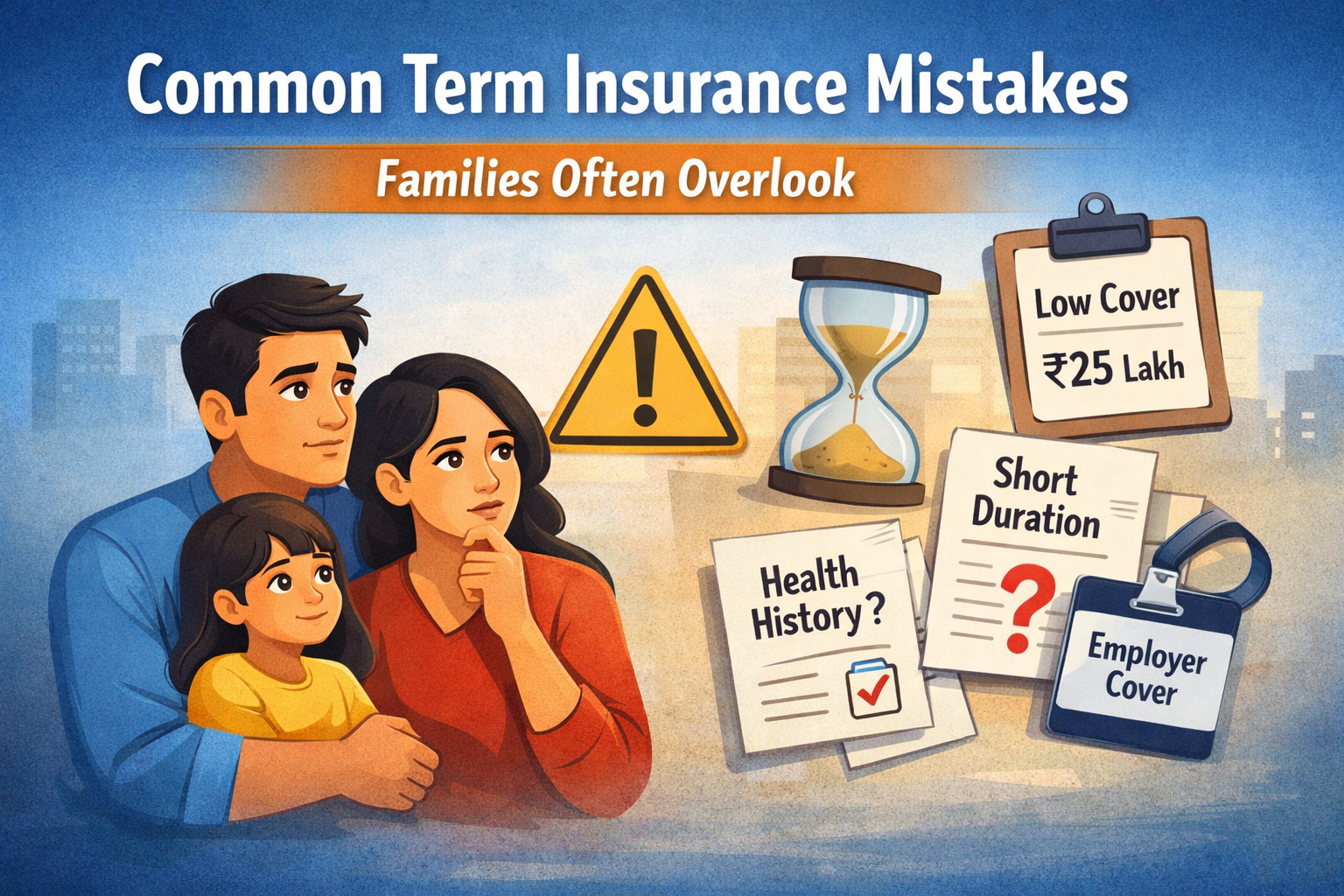

Most people buy term insurance with good intentions. They want to protect their family and move on. Because of this, decisions often happen quickly and without much thought.
At first, these choices feel harmless. Over time, however, they can weaken the very protection the policy is meant to provide. As a result, families may feel secure on paper but struggle in real life.
Term insurance itself is simple. The mistakes around it are not.
Choosing a Lower Cover Just to Save Premium
Many people choose a lower cover because the premium looks cheaper. At the time, this feels practical.
For a healthy 30-year-old non-smoker, term plans from insurers like HDFC Life, ICICI Prudential, Max Life, or Tata AIA often show numbers like these:
- ₹50 lakh cover → about ₹5,000–₹6,000 per year
- ₹1 crore cover → about ₹9,000–₹11,000 per year
Because of this difference, saving ₹4,000–₹5,000 a year feels sensible.
Now, let’s connect this to real life.
If monthly household expenses are ₹45,000, yearly expenses become ₹5.4 lakh. A ₹50 lakh cover supports these expenses for roughly 9 years, even before inflation reduces its value.
Meanwhile, children’s education, rent or EMIs, and medical costs continue for much longer. Therefore, the premium saving feels small when compared to the long-term gap it creates.
Buying Term Insurance Too Late
Many people delay buying term insurance. Some feel they are too young. Others wait for marriage or a higher income.
At age 25–30, buying a policy from insurers such as LIC or HDFC Life usually feels easy. Premiums stay low, and medical checks remain basic.
However, things change with time.
By age 40, the same person may:
- Pay nearly double the premium
- Go through detailed medical tests
- Face questions about blood pressure, sugar, or cholesterol
This happens across insurers. Age and health affect pricing everywhere. Therefore, buying early is not about fear. Instead, it is about locking cost and choice while health allows it.
Choosing Policy Duration Without Thinking About Life
Many online platforms default to 20-year policies. This happens whether you are looking at Bajaj Allianz Life or ICICI Prudential.
For a 30-year-old, a 20-year policy ends at 50.
Now ask a simple question:
Will your financial responsibilities end at 50?
For most families, the answer is no. Home loans, children’s education, and family support often continue well into the late 50s or early 60s. As a result, protection may end when it is still needed most.
Policy duration should follow life responsibilities, not default options.
Mixing Insurance With Investment
Many people dislike the idea of “no return.” Because of this, they choose plans that combine insurance with returns. Such plans exist across insurers, including LIC, Tata AIA, and HDFC Life.
In practice, a few things usually happen:
- Insurance cover stays low, often ₹10–25 lakh
- Money remains locked for long periods
- Investment flexibility reduces
For someone earning ₹12 lakh per year, a ₹15 lakh cover does not replace income meaningfully. Therefore, protection suffers while returns remain uncertain.
A simpler approach works better. Term insurance should focus only on protection. Investments should focus only on growth.
Not Disclosing Health or Habits Honestly
This mistake looks small but causes the biggest problems later.
Some people hide smoking habits or past medical issues while buying policies from insurers like ICICI Prudential or Max Life. The premium saving looks minor, so the risk feels low.
However, during claim settlement, insurers verify medical records. If mismatches appear, claims may get delayed or rejected. As a result, families face stress when support matters most.
Honesty during application protects your family far more than small premium savings.
Relying Only on Employer-Provided Insurance
Many salaried professionals depend entirely on employer life insurance. This feels convenient at first.
Employer cover usually:
- Equals 2–5 times salary
- Ends when the job ends
For example, with a salary of ₹8 lakh, employer cover may range between ₹16–40 lakh. That amount rarely supports long-term needs.
A personal term policy stays with you even when jobs change.
Simple Comparison Table: Small Choices vs Real Impact
| Area | What People Often Do | What Actually Happens |
|---|---|---|
| Cover amount | Choose ₹25–50 lakh | Cover lasts only a few years |
| Premium focus | Save ₹4–5k yearly | Large protection gap |
| Buying age | Delay purchase | Higher cost and restrictions |
| Policy duration | Pick 20 years by default | Cover ends too early |
| Plan type | Mix insurance and returns | Low cover, poor flexibility |
| Health disclosure | Hide small details | Claim problems later |
| Employer cover | Rely fully on it | Cover ends with job |
A Simple Checklist to Review Your Term Insurance
Before assuming your term insurance is sorted, pause and ask:
Does my cover replace income for 15–20 years?
Will the policy last until my real responsibilities end?
Have I disclosed all health details honestly?
Would my family manage if this amount was paid today?
Am I relying only on employer insurance?
If any answer feels unclear, the policy needs review.
Bringing It Back to You
Term insurance does not fail because of the company. Policies from LIC, HDFC Life, ICICI Prudential, or others work as designed when chosen thoughtfully.
Problems arise when decisions get rushed.
For a clearer foundation, you may also want to read our earlier guide on term insurance basics (internal link to your first blog).
To understand how inflation affects long-term expenses, you can refer to this RBI explainer:
👉 https://www.rbi.org.in/Scripts/FAQView.aspx?Id=82
Closing Note
Term insurance works quietly in the background. When chosen carefully, it protects everything else you are building. When chosen casually, it creates comfort without real security.
If you’d like to discuss these points in the context of your own situation, you’re welcome to schedule a conversation at your convenience.
This financial literacy is very important and is to be reached out to many people, great work sir keep going .